ChatGPT for Academic Writing: A Strategic Guide for Edupreneurs & EdTech Platforms (2026)
Learn how edupreneurs and edtech platforms can use ChatGPT for academic writing in 2026. Discover AI-powered frameworks, real use cases, and strategies to improve student outcomes while maintaining academic integrity.
EDTECH & AI
Academic Writing Assistant Team
4/7/20264 min read
Most educators think they are in control of how students write. They’re not. Students are already using ChatGPT—quietly, efficiently, and often without guidance.
And here’s the uncomfortable truth:
Students are adopting AI faster than educators are adapting to it.
Ignoring this shift doesn’t protect academic integrity. It weakens it.
Because when AI is used without structure, it leads to:
Shallow thinking
Generic outputs
Invisible dependency
But when guided intentionally, the same tool becomes something far more powerful:
A writing coach, thinking partner, and scalable teaching system
This guide is not for students looking for shortcuts.
It is for edupreneurs, course creators, and edtech builders who want to design AI-first academic writing ecosystems.
Why ChatGPT in Academic Writing Is an Opportunity (Not a Threat)
Search behaviour tells a clear story.
Students are actively looking for:
”Effective Strategies for Incorporating AI in Writing Instruction”
“AI tools for essays and assignments”
“Can ChatGPT write research papers?”
The demand is already there.
The real gap?
Guidance, structure, and pedagogy
This creates a powerful opportunity for edupreneurs:
Build AI-integrated writing programs
Offer structured academic workflows
Position yourself as a future-ready educator
And for edtech platforms:
Create AI-powered writing copilots
Deliver personalised feedback at scale
Increase engagement through intelligent systems
This is not about keeping up.
It’s about leading the shift from content delivery → intelligent learning design.
A Contrarian Insight: Banning AI Is Not a Strategy
Many institutions are still reacting to AI with restrictions.
But let’s be direct:
Banning ChatGPT is not educational integrity—it’s avoidance.
Students will still use it. The only difference is:
With guidance → learning improves
Without guidance → learning degrades
Education was never meant to be about controlling tools. It was meant to be about shaping how tools are used.
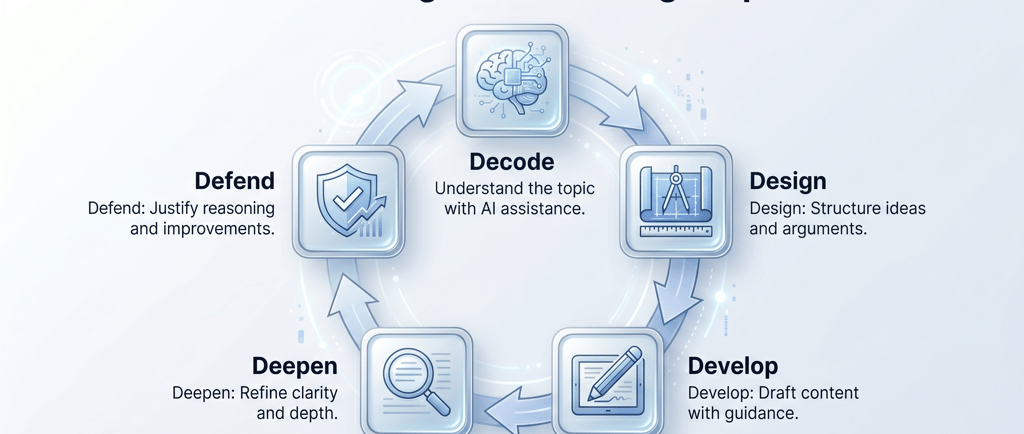
The AI-Augmented Writing Loop (A Practical System for Educators)
Most AI usage fails because it focuses only on output. Real learning happens in the process.
Here’s a refined system you can implement:
The AI-Augmented Writing Loop
1. Decode
Students use AI to understand the topic deeply
(“Explain this concept with real-world examples”)
2. Design
Generate and critique structured outlines
(“Create a structured argument for…”)
3. Develop
Write drafts with guided AI assistance—not full automation
4. Deepen
Refine language, clarity, and argument strength
5. Defend
Students justify their ideas, edits, and reasoning
Why This Works:
Moves students from passive generation → active thinking
Builds ownership and clarity
Makes AI part of the learning loop—not the end result
👉 Most educators stop at drafting.
The real transformation happens in deepening and defending.
How Edupreneurs Can Build AI-Powered Academic Writing Systems
This is where you move from using AI to designing with AI.
1. Shift from Teaching Writing → Teaching Thinking Systems
Instead of asking:
“Write an essay”
Design tasks like:
Generate → Critique → Improve → Justify
Example:
Students create an AI-generated outline and explain:
What they changed
Why they changed it
What improved
This builds critical thinking—not dependency
2. Create Structured Prompt Libraries (Your First Product Layer)
Most students struggle not with writing, but with asking the right questions.
You can create:
Essay prompts
Research prompts
Editing prompts
Reflection prompts
This becomes a monetisable asset inside your course or platform.
3. Build AI Feedback Loops (Your Differentiation Engine)
Feedback is where most educational systems fail.
With AI, you can:
Offer instant writing feedback
Simulate peer review
Enable multiple draft iterations
Mini Case Narrative:
An online IELTS educator integrated AI into their writing evaluation process.
Before:
25–30 essays/day max
Delayed feedback
Student frustration
After integrating ChatGPT workflows:
Instant first-level feedback
70% reduction in evaluation time
Students submitted 2–3x more drafts
The result wasn’t just efficiency—it was deeper learning through iteration
4. Design AI-First EdTech Features (Beyond Content)
When developing a platform, consider approaches that extend beyond basic AI tool integration.
Think in terms of product experience:
AI Writing Copilot: Guides students step-by-step
Prompt-to-Feedback Engine: Input → structured evaluation
Draft Comparison View: Shows improvement across iterations
AI Confidence Score: Highlights weak arguments
Monetisation Insight:
You can structure features as:
Free → Basic AI assistance
Premium → Advanced feedback + writing analytics
👉 AI is not just a feature—it’s a revenue lever
Best Practices for Using ChatGPT in Academic Writing (For Educators)
Teach AI Literacy Explicitly
Students must learn:
Prompt design
Output evaluation
Iterative refinement
Evaluate the Process, Not Just the Output
Focus on:
Draft evolution
Thought clarity
Argument strength
Encourage Transparent AI Usage
When students disclose usage, trust increases.
Keep Human Judgment Central
AI can assist—but education remains human at its core.
Common Mistakes Edupreneurs Must Avoid
❌ Ignoring AI
Students will still use it—just poorly.
❌ Over-Automating Learning
Efficiency without thinking leads to fragility.
❌ Treating AI as a Threat
This mindset blocks innovation.
The Smarter Approach:
Build systems where AI amplifies thinking—not replaces it.
What Your Audience Is Actually Searching (SEO Layer)
To position your platform effectively, align with these queries:
ChatGPT for educators
AI tools for academic writing
AI in education examples
Academic writing automation tools
Utilising ChatGPT to Support Academic Writing
👉 This is where AI + education + productivity intersect
Frequently Asked Questions (FAQ)
Can educators allow ChatGPT in academic writing?
Yes—when structured properly, AI can enhance learning while maintaining academic integrity.
How can edtech platforms integrate AI writing tools?
By embedding AI into writing assistants, feedback systems, and learning dashboards.
Does ChatGPT reduce critical thinking?
Only when misused. In structured systems, it actually enhances analytical depth.
What is the best way to teach AI writing tools?
By focusing on:
Prompting
Critiquing
Iterating
Reflecting
Is ChatGPT reliable for academic content?
It’s a strong starting point—but must always be verified and refined.
The Future: AI-First Academic Ecosystems
We are moving toward a model where:
Writing is AI-assisted by default
Educators act as mentors, not information providers
Platforms deliver intelligent, adaptive learning systems
The question is not whether AI will be used.
The question is:
Who will teach students to use it well?
Final Thoughts
Education was never meant to be efficient.
It was meant to be transformative.
AI forces us to confront that difference.
If we use it blindly, we create faster learners with weaker thinking.
If we use it wisely, we create independent thinkers with powerful tools.
So, if you're an edupreneur or edtech founder looking to:
Integrate AI into your academic programs
Build scalable writing systems
Improve student outcomes through structured workflows
You don’t need more tools. You need the right system.
Download our “AI Writing Prompt Library for Educators”
or
Explore how Academic Writing Assistant helps you design AI-first learning systems
Phone +91-8076692199
hello@academicwritingassistant.com
Contact
Building structured, scalable academic content systems with clarity and purpose.
© 2026 All rights reserved.
Get in Touch
Other Pages : Privacy Policy